Skip to content
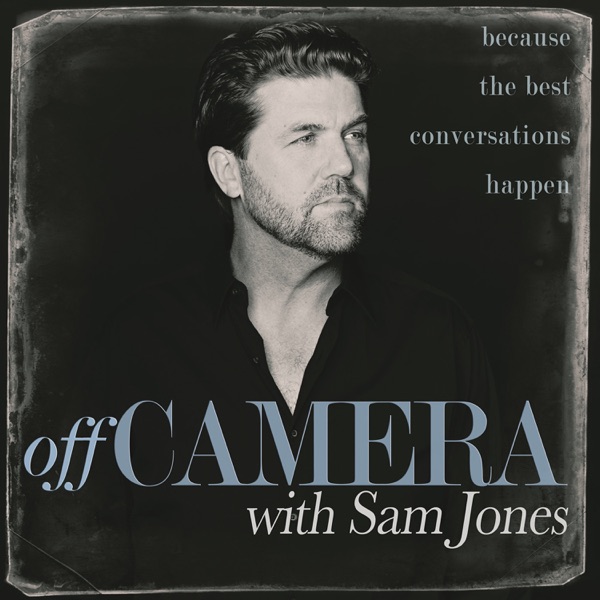
Off Camera with Sam Jones cover art

Sam Jones

Off Camera with Sam Jones

A Arts and TV & Film podcast Explicit

Good podcast? Give it some love!

About the show

Off Camera is a podcast hosted by photographer/director Sam Jones, who created the show out of his passion for the long form conversational interview, and as a way to share his conversations with a myriad of artists, actors, musicians, directors, skateboarders, photographers, and writers that pique his interest. Because the best conversations happen Off Camera.

Newest episodes

Ep. 6 Tony Hawk (first aired Nov. 25, 2013)

1 hr 18 min

If pro skateboarders have resumes, Tony Hawk’s is undoubtedly among the longest and most envied. Though he’s the most decorated skater ever with the highest contest win percentage of any sport and a $1 billion video game series, Hawk has arguably given more to the sport than he’s received. Watching Hawk skate is testament to creativity and artistry as much as athleticism, as is his autobiography, which required a glossary to catalog the tricks that are his legacy to the skateboarding lexicon. His Tony Hawk Foundation has contributed over $4 million to develop 500 skate parks around the world. He’s also been skating’s foremost advocate, promoting it through some of its darkest days (though smashing his pelvis while attempting a full loop dressed in a gorilla suit probably doesn’t count). Hawk joins Off Camera to talk about the evolution of the sport from its scrappy underground beginnings to X Games behemoth. He shares his thoughts on the vital role of creativity and artistry in athletics and his continued love and commitment to the sport. Now a father of 4 that can still stick the most difficult tricks ever invented, we learn why at 44, he still makes his primary living on four wheels.

Ep. 5 Robert Downey Jr.

1 hr 11 min

“Moral certainty is always a sign of cultural inferiority. The more uncivilized the man, the surer he is that he knows precisely what is right and what is wrong. The truly civilized man is always skeptical and tolerant, in this field as in all others. His culture is based on ‘I am not too sure.’" -H.L. Mencken Henry Louis Mencken and Robert Downey Jr. did not cross paths in life (though it’s fun to imagine that conversation), but the essayist’s quote is an apt description of the actor’s approach to life. Downey’s restless intelligence is reflected in his ability to express several contradictory points of view simultaneously, making sense all the while. He can be direct one moment and elusive the next, often spinning off on seemingly unrelated tangents. But like watching a juggler on a wire, being in Downey’s presence is a riveting experience. For someone who almost from the outset was deemed “the greatest actor of his generation”, the majority of Robert Downey, Jr.’s career has been filled with big commercial flops, “critically acclaimed” flops, very public struggles with drugs and more than a little jail time – all of which have landed him squarely in some of the biggest blockbuster films in recent history. It’s an unlikely hero story, but then Robert Downey Jr. is an unlikely hero. With the release of the final film in the Iron Man trilogy, it’s ironic to contemplate that the studios also didn’t see him as a hero, least of all an action hero. Downey disagreed. At once supremely convinced of his own talent and extremely humble, he fought hard for the role of Tony Stark when the studio flatly refused to even let him audition. He prepped intensely, though for other roles he admits he’s just as likely to wing it. Downey is an enviably comfortable resident of the gray area we all inhabit. He is (somewhat) remorseful about his jail time but without resentment towards the upbringing that arguably introduced him to the lifestyle that led him there (“I choose to see it...

Ep. 4 Aimee Mann

1 hr 28 min

Aimee Mann, the Boston born singer/songwriter, Grammy winner and self-described Oscar loser, was recently named to NPR’s list of the ten finest living songwriters. It was a well-deserved honor, and put her in the company of artists like Bob Dylan, Paul McCartney, and Tom Waits. While Aimee Mann is widely acknowledged for her songwriting talent, her lesser-known role as an industry trailblazer is as laudable as it is fascinating. Starting with the sudden and disconcerting fame of her band ‘Til Tuesday and spanning eight solo albums, the arc of her career has largely reflected, and in some ways shaped, the music business itself. Much of that career was defined by her struggle and just plain bad luck with record labels that couldn’t see past Mann’s model looks and the dollar signs in their eyes that she was not the artist they were molding her to be. In her struggle to stay true to herself as an artist, Mann chafed under contracts and finally started her own label in order to put out her finely-observed songs the way she wanted to put them out – a ground-breaking move at the time and one that paved the way for musicians just starting to navigate the chaos of the music business today. The irony? With no more Goliath labels to fight and at the absolute peak of her talent as a songwriter, the channels for distributing and making a living from music are disappearing. With surprising humor and optimism, Mann lets us in on her bumpy journey, a few surprising hobbies and why, after a career-long struggle to make a living with her art, she believes there’s always a next step.

Similar podcasts

All episodes

The newest 50 of 269 episodes

Ep. 6 Tony Hawk (first aired Nov. 25, 2013)

1 hr 18 min

If pro skateboarders have resumes, Tony Hawk’s is undoubtedly among the longest and most envied. Though he’s the most decorated skater ever with the highest contest win percentage of any sport and a $1 billion video game series, Hawk has arguably given more to the sport than he’s received. Watching Hawk skate is testament to creativity and artistry as much as athleticism, as is his autobiography, which required a glossary to catalog the tricks that are his legacy to the skateboarding lexicon. His Tony Hawk Foundation has contributed over $4 million to develop 500 skate parks around the world. He’s also been skating’s foremost advocate, promoting it through some of its darkest days (though smashing his pelvis while attempting a full loop dressed in a gorilla suit probably doesn’t count). Hawk joins Off Camera to talk about the evolution of the sport from its scrappy underground beginnings to X Games behemoth. He shares his thoughts on the vital role of creativity and artistry in athletics and his continued love and commitment to the sport. Now a father of 4 that can still stick the most difficult tricks ever invented, we learn why at 44, he still makes his primary living on four wheels.

Ep. 5 Robert Downey Jr.

1 hr 11 min

“Moral certainty is always a sign of cultural inferiority. The more uncivilized the man, the surer he is that he knows precisely what is right and what is wrong. The truly civilized man is always skeptical and tolerant, in this field as in all others. His culture is based on ‘I am not too sure.’" -H.L. Mencken Henry Louis Mencken and Robert Downey Jr. did not cross paths in life (though it’s fun to imagine that conversation), but the essayist’s quote is an apt description of the actor’s approach to life. Downey’s restless intelligence is reflected in his ability to express several contradictory points of view simultaneously, making sense all the while. He can be direct one moment and elusive the next, often spinning off on seemingly unrelated tangents. But like watching a juggler on a wire, being in Downey’s presence is a riveting experience. For someone who almost from the outset was deemed “the greatest actor of his generation”, the majority of Robert Downey, Jr.’s career has been filled with big commercial flops, “critically acclaimed” flops, very public struggles with drugs and more than a little jail time – all of which have landed him squarely in some of the biggest blockbuster films in recent history. It’s an unlikely hero story, but then Robert Downey Jr. is an unlikely hero. With the release of the final film in the Iron Man trilogy, it’s ironic to contemplate that the studios also didn’t see him as a hero, least of all an action hero. Downey disagreed. At once supremely convinced of his own talent and extremely humble, he fought hard for the role of Tony Stark when the studio flatly refused to even let him audition. He prepped intensely, though for other roles he admits he’s just as likely to wing it. Downey is an enviably comfortable resident of the gray area we all inhabit. He is (somewhat) remorseful about his jail time but without resentment towards the upbringing that arguably introduced him to the lifestyle that led him there (“I choose to see it...

Ep. 4 Aimee Mann

1 hr 28 min

Aimee Mann, the Boston born singer/songwriter, Grammy winner and self-described Oscar loser, was recently named to NPR’s list of the ten finest living songwriters. It was a well-deserved honor, and put her in the company of artists like Bob Dylan, Paul McCartney, and Tom Waits. While Aimee Mann is widely acknowledged for her songwriting talent, her lesser-known role as an industry trailblazer is as laudable as it is fascinating. Starting with the sudden and disconcerting fame of her band ‘Til Tuesday and spanning eight solo albums, the arc of her career has largely reflected, and in some ways shaped, the music business itself. Much of that career was defined by her struggle and just plain bad luck with record labels that couldn’t see past Mann’s model looks and the dollar signs in their eyes that she was not the artist they were molding her to be. In her struggle to stay true to herself as an artist, Mann chafed under contracts and finally started her own label in order to put out her finely-observed songs the way she wanted to put them out – a ground-breaking move at the time and one that paved the way for musicians just starting to navigate the chaos of the music business today. The irony? With no more Goliath labels to fight and at the absolute peak of her talent as a songwriter, the channels for distributing and making a living from music are disappearing. With surprising humor and optimism, Mann lets us in on her bumpy journey, a few surprising hobbies and why, after a career-long struggle to make a living with her art, she believes there’s always a next step.

Ep. 3 Blake Mills

1 hr 8 min

After releasing two records with his former band Simon Dawes (now Dawes), guitarist/producer/songwriter Blake Mills went on to become a go-to touring guitarist and session musician for acts including Jenny Lewis, Band ofHorses, Julian Casablancas, Lucinda Williams, Fiona Apple, Conor Oberst, Kid Rock, Norah Jones, Lana Del Rey and Danger Mouse. A lifetime of career experience for most musicians, it constitutes Mills’ resume at just 26 years of age. Impressive, even given that he played his first gigs at 13 (in bars…but that’s another story). Mills encompasses several rare dichotomies: A true intellectual and a pop/rock musician; a supremely accomplished guitarist and also a songwriter to be reckoned with; and a virtuoso who doesn’t let his virtuosity get in the way of making great music. Mills talks to Off Camera about how his autodidact approach informed his musical development, how today’s musicians and fans are both helped and hurt by vast access to music online, escaping a career in football and what he and some talented collaborators are doing hosting public jam sessions in a surf shop. If Mills’ name isn’t more well known, perhaps it’s because he works pretty hard to remain low key. That may just change with the growing popularity of his first solo album, Break Mirrors.

Ep. 2 John Krasinski

1 hr 33 min

As Jim Halpert, John Krasinski embodies The Office’s most beloved Everyguy, but his middle-achiever alter ego belies the actor’s impressive and accomplished resume. At just 33, he has written, directed and produced both television and feature films with some of the industry’s most talented heavy-hitters. Krasinski shares his own version of the waiter-to A-list story and talks about staying true to his artistic path despite periods of self-doubt. An avid and humble student of experience, he discusses what he’s learned from his work with industry veterans such as Sam Mendes, Gus Van Sant and George Clooney. Krasinski talks to Off Camera about wrapping the final season of The Office, the value of supportive parents, and about his newest film, Promised Land, which he co-wrote, and co-stars with Matt Damon. At one of the most interesting junctions in his career, an actor who’s arguably done it all looks ahead to what he hopes will be next.

Ep 1. Val McCallum

53 min

Whether or not you’ve heard of Val McCallum, you’ve undoubtedly heard his work. Val is a supremely talented guitarist, singer, songwriter and studio musician who got his start recording for the legendary songwriter Harry Nilsson at age 18. After 30 years of working with such artists as Jackson Browne, Lucinda Williams, The Wallflowers, Bonnie Raitt, and countless others, Val McCallum has released his first solo record. Entitled At the End of the Day, it is a collection of spare, acoustic and grippingly intimate songs. We grabbed Val between stops on his current tour with Jackson Browne and gigs with his own wickedly humorous country band Jackshit, where he performs as alter ego Beau Shit along with bass player Davey Faragher and drummer Pete Thomas, who make their living as Elvis Costello’s rhythm section. Val grew up in Los Angeles and is the son of actor David McCallum and actress Jill Ireland, but Ireland raised Val and his brothers Jason and Paul with Charles Bronson, who she married when Val was a young boy. Val discovered the guitar at age eight, and arguably hung on to it for dear life through some tough twists and turns, including the tragic death of his brother Jason and the loss of Ireland to cancer. In “At The End of the Day,” Val opens these wounds and sings with touching candor about themes that are at once deeply personal and universally human. It’s a record about loss, grief and loneliness that somehow manages to create a mood of catharsis, promise and understanding. Reminiscent of early Neil Young, Nick Drake and Crosby Stills and Nash, “At the End of the Day” is an achievement of understated beauty. In this episode, Sam Jones talks to Val McCallum about his experiences making records with so many iconic artists, and about the process of making his own. So pull up a chair and listen in.

Ep 133. Danai Gurira

1 hr 5 min

The talented and worldly Danai Gurira has been bridging the gap between disparate worlds ever since her family moved from Grinnell, IA to Africa when she was a toddler. In school, the self-described Zimerican (Zimbabwean-American) was the “African kid with a twangy American accent” who got along with everybody regardless of race and class. That ability to cross borders both artistic and geographic has defined Danai’s career. On the blockbuster side, Danai inhabits the character of Okoye in the highly anticipated Marvel film Black Panther and the character of Michonne, the butt-kicking zombie killer in AMC’s hit series The Walking Dead. On the literary side, she’s a playwright with Broadway success who mingles with the high-brow theatre crowd. But don’t get caught up in Western delineations between actor and writer because at her core, Danai is a storyteller—a woman who uses her unique perspective and artistic talent to reveal the shared humanity between seemingly different worlds of Africa and America. Danai points out that talent must be nurtured and distractions must be set aside because “the whole goal of storytelling is to became a worthy enough vessel for the story to come through you.” Danai joins Sam Jones to discuss the nuanced world of Ryan Coogler’s Black Panther, auditioning for The Walking Dead, overcoming grad school breakdowns, and discovering her artistic mandate.

Ep 7. Dave Grohl

1 hr 1 min

Being a bona fide badass is the price of entry for a career in rock and roll; and if you ask Dave Grohl, it’s the key ingredient for just about anything worth doing. His approach to life has fueled the Foo Fighters’ 20 year,11 album career and garnered him a following of very stoked rock fans, many of who gathered at this year’s SXSW music conference to hear Grohl’s keynote address. The hipsters, rockers, start-uppers and next-big-thing developers packing the room were no doubt curious to hear how one goes about dropping out of high school, rising to fame as the drummer in Nirvana (a small Northwest act you may have heard of), and then go on to lead one today’s few remaining true rock bands? For Grohl, the answer’s pretty simple: figure out who you are and what inspires you and don’t look back – develop that individuality by working as hard as you can at what you love. That clarity of approach drove not only his Nirvana/Foo Fighters trajectory, but numerous musical side projects like Queens of the Stone Age, and Them Crooked Vultures. And most recently, a new artistic title: documentarian. He didn’t know anything about the film making process except what he needed to know most: Passion for your subject is sine qua non; and not one to do anything without it, Grohl didn’t question himself. Nor apparently did Rick Springfield, Neil Young, Stevie Nicks, Paul McCartney, and Tom Petty, all subjects of Sound City, his fascinating documentary about the people behind the studio that launched an amazing roster of legendary music acts. For a guy who admits to still feeling like a 13 year old and dressing like a 17 year old, Grohl has something to teach all of us…and shares it with Off Camera in one of our most inspiring interviews to date.

Ep 156. Awkwafina

1 hr 3 min

Awkwafina (also known as Nora Lum) is having quite a moment. She’s a part of the impressive cast of female icons (Sandra Bullock, Rihanna, Cate Blanchett, and more) in Ocean’s 8, and she’s so hilarious in Crazy Rich Asians that you’ll barely hear her next line over the sound of your own laughter. What does this moment in the spotlight feel like? Awkwafina likens it to this: “I compare it to a wall opening up and transporting you to an alternate dimension where there is no gravity, and everything is weird.” Her initial shock isn’t so strange when you consider the fact that she never allowed herself to dream of a career in the arts, and there weren’t exactly any female Asian-American actress/rapper hybrids to pave the road to possibility. Awkwafina tried to follow the path that her friends took after college, but living the buttoned-up office life of a publicity assistant in Manhattan wasn’t really her thing. When her boss made her choose between her music and her unfulfilling job, it wasn’t much of a contest—not only because she got fired, but especially because her identity was at stake. As she explains, “If I didn’t have my music, then I didn’t have an identity.” With nothing to lose, she decided to post her “My Vag” music video on Youtube, in which she hilariously raps about the superiority of her genitalia. After the push of a “Publish” button, Awkwafina became a viral success—and the rest is herstory. As the first Asian-American actress/rapper of any consequence, Awkwafina acknowledges, “Being the first sucks, but I found what I love. I found what I always dreamt of as a kid that would connect with adulthood. It’s so powerful for me. I finally feel like I can walk and know what I’m doing. I know why I’m there.” Awkwafina joins Off Camera to talk about embracing the responsibility that comes with being an Asian-American actor in Hollywood, discovering her comedic talents post personal tragedy, and why Margaret Cho is her spirit animal.

Ep 140. John Goodman

1 hr 0 min

John Goodman wasn’t always the imposing presence he is today, but he’s always had his charisma. As an eighth grader in Missouri, John charmed the “hard guys” in school with a spot-on Gomer Pyle impression so they would protect him. As he explains, “I was a little fat kid. I had the glasses with the tape in the middle. I was nerdy, man.” Heavily influenced by Marlon Brando and captivated by the language of Shakespeare, John discovered his dream to become an actor and left the Midwest to make it happen. After a stint as Thomas Jefferson in a dinner theater rendition of 1776, John found commercial success in New York City, but his career really took off when Roseanne came along in the late ‘80s. He’s also been a fixture in Coen brothers’ movies (Raising Arizona, Barton Fink, The Big Lebowski, and more), bringing his characteristic physicality to roles that simmer with an explosive energy. Exhibit A—screaming obscenities and beating the bejesus out of a Corvette with a crow bar in The Big Lebowski. That on-screen volatility was also present in John’s off-screen life. Decades of heavy drinking forced John to confront his demons, and as a self-described “egomaniac with an inferiority complex,” he has come out the other side with humility, grace, and an endearingly self-deprecating sense of humor. His perspective on his life and career is downright fascinating. John brings candor and wit to our Off Camera conversation. We discuss why “everything is on the page” with the Coen brothers, how Roseanne came back after a 21-year hiatus, why John looked for trouble in Central Park, and how the movie Animal House was a terrible influence on him.

Ep 50. Aubrey Plaza

1 hr 4 min

When the notoriously poker-faced Aubrey Plaza says that she’s wanted to be an actor since she was 13 and thus isn’t surprised it’s happening, or that perhaps the universe responded to her acting daydreams, you have to wonder, does she really mean that? Understandably, Aubrey Plaza used to hate the word “deadpan,” as associated as it’s become with the detached, almost unreadable delivery she’s cultivated as characters like Julie Powers in Scott Pilgrim vs. the World, Darius in Safety Not Guaranteed and perhaps most famously, Parks and Recreation’s wryly impassive April Ludgate. Then her Ned Rifle director Hal Hartley cast the term in a different light: maybe it occasionally serves a character to drop lines with a certain lack of personal involvement. Though no one expects much from a zombie in the way of emoting, The Guardian said of Life After Beth, “…Plaza steals the show with one foot in the grave, her rotting heroine ricocheting between adolescent snarkiness and cadaverous rage…” When you think about it, it takes a certain amount of equanimity to put a line out there and let it sit without telegraphing what we’re supposed to think about it or how we’re supposed to react. If that means viewers remain a bit off balance, all the better to hold our attention while we supply our own context. But back to those comments. She was (we’re pretty sure) quite sincere, though Plaza herself likely had more to do with moving her career along than the universe. Philosophically, she seems to fall somewhere between fatalism and determinism. When her mom introduced her to Saturday Night Live, young Aubrey decided it was her dream job. When she looked up cast member bios and saw standup comedy as the common thread among her idols, she went promptly into improv, and later actually interned at SNL. Shortly after, she started growing the career she’s still building today with drolly arresting roles in films like Funny People and About Alex and The To Do List, often playing younger, s...

Ep 134. Common

59 min

Common is a man who is anything but, and he’s been evolving as an artist since the start of his three-decade-and-counting career when he was a young musician rapping about his love for hip-hop. These days, in addition to being a Grammy-winning artist, Common is an established actor, known for his work on AMC’s Hell on Wheels and films like American Gangster, Selma, and Just Wright. Common is what you’d call a conscious artist—someone who uses his platform to encourage social and political change. He believes it’s the responsibility of an artist to say, “I see what you’re going through, and I’m going to stand up and use my voice, my talents, and my energy towards making your world better.” In his song “Black America Again,” he uses the power of music to show us the problems that arise from systemic racism and what we can do to resolve them. Despite his success, he’s not living a life disassociated from the, er, common people. You might even catch him writing a new song in his car if you find yourself in traffic on the 405. Ultimately, Common is an artist who cherishes the opportunity to grow and evolve, so if he has it his way, he’ll be freestyling into his seventies. Common joins Off Camera to discuss the responsibility of an artist, the socio-economic underpinnings of hip-hop braggadocio, and why he loves to feel nervous when he’s starting a new project.

Ep 25. Jessica Chastain

1 hr 1 min

What does it take to feel confident that you’ve made it in Hollywood? “Coming from nowhere with no connections” and going almost overnight to A-list status with leads in a string of the most highly acclaimed films in recent history would do the trick. So would a modest but steely belief that acting is what you’re meant to do, and always will do. Jessica Chastain wasn’t always certain of her path, but she never questioned her destination. That helps when you find yourself going to audition after audition with zero film work to show casting directors. Though daunting, it allowed her the rare opportunity to enter wide public and industry consciousness with a series of performances as revelatory as they were different in Jolene, Tree of Life, The Help and Zero Dark Thirty. While deeply appreciative of the experiences those films earned her to work with some of the most innovative and talented directors and cinematographers in the business, Chastain says she still feels the need to eventually take her roles away from the writers and directors with whom she collaborates. Call it an overdeveloped sense of ownership; but it’s the kind of ownership that creates characters whose inner life is so transparent that we’re along for the ride from first frame. But perhaps the most admirable and inspiring aspect of her position in Hollywood is how she’s using it to advocate for a much-needed increase in female presence, perspective and opportunities in the industry she loves. She knows bringing Off Camera votes Jessica Chastain for Best Actress…and maybe for President.

Ep 46. Joseph Gordon-Levitt

1 hr 1 min

One of best ways to enter and appreciate the original, prolific brain of Joseph Gordon-Levitt is through the lens of hitRECord, the open, collaborative production company he founded in 2005, and one of the most creative and inspiring uses of the Internet ever. Its nearly 100,000 members submit projects – films, stories, songs, drawings, you name it – for other members to edit, build on and evolve. Gordon-Levitt credits directing short films on hitRECord with teaching him what he needed to know to make Don Jon, his first feature film as a writer, director and star. It was a darkly comic but ultimately hopeful tale about what happens when we become too connected to our devices, consuming people as things and communicating at versus with each other. His effort was rewarded with critical acclaim rare for actors who have the audacity to become auteurs; more importantly, audiences dug it. A lot of artists might find hitting it out of the park on their first time at bat daunting, but it just made him want to do more, and on a more collaborative level. That’s because Gordon-Levitt has never been fond of one-way streets – not for communication, not for critiques, not for creating, and especially not for careers. He could’ve ambled down his own pretty easy and lucrative path after early childhood success in commercials, films and most famously, NBC’s hit sitcom 3rd Rock from the Sun. Instead, he went to Columbia University, largely out of a desire to reclaim the feeling of “not knowing what I was going to be” – an open question for many college freshmen, but few actors who’ve worked steadily from the age of four. When he found himself roaming the streets of New York with a video camera, he knew a return to acting was inevitable, but he knew it would have to be in unexpected roles – not to make an artistic statement, but to prove to the business (and himself) that he didn’t have to be just one thing. When such roles weren’t immediately forthcoming, his restless creativity fo...

Ep 72. Mindy Kaling

59 min

Much has been made–justifiably so–about the anemic diversity represented in film and television, most problematically when roles originally written for people of color are rewritten for white actors. So consider if you will the concept of a 5’ 4” woman of Indian descent writing and playing the part of a famously strapping white male actor – in 2002, no less. The off-Broadway play (that would be Matt & Ben, in case you were wondering) hardly seems like the breakout opportunity of a lifetime for anyone. But Vera Mindy Chokalingam, 23 years old and barely out of college at the time, is about as un-anyone as they come. Matt & Ben was named one of Time magazine’s “Top Ten Theatrical Events of the Year,” and its co-writer/co-star (better known these days as Mindy Kaling) praised by The New York Times for her fine, deadpan sense of the absurd and the vicious. As fateful showbiz stories often go, in the audience one night was producer Greg Daniels, who was working on an American adaptation of The Office. He hired Kaling as a writer-performer on the show. Make that the only female writer on a staff of eight, and soon its most prolific. “Your average writer, when they get really good, I know how they got it,” Daniels told The New York Times. “I can see the steps. But I love how with Mindy, I don’t see how she does it.” We have a speculation or two. Kaling grew up on Fawlty Towers and Saturday Night Live, and says she realized pretty early on that the only thing she really liked doing was writing dialogue. Listening to the characters on her shows, you get the feeling that there’s so much rapid-fire conversation looping in her head that it’s all she can do to keep up; no wonder Kelly Kapoor, Mindy Lahiri and their co-workers seem to spring fully formed like mini-Athenas from the crowded forehead of a comic Zeus. It also spills over into books (Is Everyone Hanging Out Without Me? And Other Concerns and Why Not Me?) and a Twitter feed as random and entertaining as it is followe...

Ep 96. Courteney Cox

58 min

So no one told her life was going to be this way. Except Friends director Jimmy Burrows, who took Courteney Cox and her fellow cast members to dinner in Vegas, telling them to enjoy the last time they'd ever be able to go out together in public without causing total pandemonium. For Cox, who never had a master plan, it was the start of what was arguably the most successful 18-year run on series television, after which some actors might welcome a break and a margarita or two. Others might freak out just a bit. You probably know what camp she falls in. We talk to Cox about her meteoric acting career, what it's like to simultaneously finance and direct an independent film, learning her craft on the fly, and how none of it would have ever happened if Brian De Palma had actually listened to her back in 1984.

Ep 168. Matt Damon 2

1 hr 5 min

For those of you watching this week’s Off Camera episode, do not adjust your sets…that is me sitting across from Matt, humiliatingly dressed head to toe in a Red Sox uniform, having lost a bet to Matt when my beloved Dodgers lost in the world series for the second year in a row. And for those of you listening or reading, well, just imagine my shame. For as long as Matt Damon can remember, he wanted to be an actor. So much so that he started his college essay with those very words. But before all the accolades and success, Matt was just a kid from Cambridge, MA who loved playing sports and watching movies. His chances of becoming a pro athlete came up short (both literally and figuratively), but he was determined to make a career out of acting after the seed was planted by an influential theater teacher and nurtured by his best friend and fellow cinephile Ben Affleck. They had no road map for success, but Matt and Ben had an advantage over their teenage peers—they just wanted it more. They took the train from Boston to New York regularly for auditions, using money drawn from their communal acting bank account to cover expenses. Eventually, one of those auditions turned into a small part in the 1988 Julia Roberts feature Mystic Pizza, but Matt’s “big break” proved to be elusive. He auditioned for the eventual Academy Award winner Dead Poets Society but was rejected in favor of Ethan Hawke, and the cruel reality of the industry smacked him in the face when he was working at the local movie theater the following summer: “I went from the possibility of being in this great film to the guy tearing the movie ticket and watching people come out crying because they’re so moved. That’s the range in this business.” So Matt and Ben decided to take fate into their own hands and write a great film that they could both star in. That was how Good Will Hunting and the acclaimed acting careers of Matt and Ben came into being. It’s been 20 years, and Matt’s career is still going str...

Ep 164. Mary Elizabeth Winstead

57 min

Mary Elizabeth Winstead’s first true love was the ballet, but her body had other plans, and she grew a bit too tall for the grande jeté. Luckily, her favorite parts about ballet—performing, telling a story, playing different characters—are all essential tenets of acting, and Mary found herself in love anew. Her early experiences acting reinforced her love of the craft, but as she got older, she struggled to find her artistic place in an industry where women are often saddled with objectification and unwanted sexual attention. But it was when Mary faced the prospect of quitting that she found her voice, and became willing to say no. She also started choosing roles that weren’t based on her beauty or desirability. “I’d always prefer to take a great role in a weird horror film over playing somebody’s girlfriend in another actor’s big vanity piece.” Her dedication is evident in her work. She’s turned in incredible performances in films like Smashed, Alex of Venice, and in Noah Hawley’s hit television series Fargo. That trend continues in her newest film All About Nina in which she plays a standup comedian who is struggling to grapple with her own emotional turmoil. Mary joins Off Camera to talk about the challenges she’s faced as a woman in Hollywood, why making a performance human and believable is so essential to storytelling, and why she’ll never step foot in a casting office bathroom.

Ep 89. David Oyelowo

1 hr 21 min

David Oyelowo has a favorite phrase from St. Francis of Assisi. “Preach the gospel, and every now and again use words.” You could see why. One of the most remarkably talented film and stage actors working today, he employs words to stunning effect, but it’s between syllables that one sees his real power. There’s something in his being that telegraphs a certain dignity, a deep human awareness and an underlying joy that he seems incapable of turning off, on screen or in person. “He’s kind of an amazing balance of import and also a kind of levity and light,” said J. J. Abrams, producer of Oyelowo’s upcoming film The God Particle. He’s best known for his acclaimed portrayal of Martin Luther King Jr. in Selma, in which his embodiment of a man raised to sainthood status as one also troubled by fear and doubt was praised most widely for its authenticity. That lack of hagiography may be partly due to an outsider’s perspective. Race played a significant, but different role in his life. He was born in London to Nigerian parents who moved the family to Lagos when he was six, and back when he was 14. Comparatively privileged in Nigeria where classmates called him coconut (white inside) and in more humble circumstances in the UK, he never completely fit. He took nothing for granted other than his own self-worth, and the importance of bettering himself. Despite being a hard worker and ambitious, he admits to enrolling in a youth theater program only because a girl he liked invited him. Oyelowo didn’t share his decision to pursue acting with his father (who was thinking along more lawyerly lines) until he’d secured a scholarship to London Academy of Music and Dramatic Art. He was offered a season with the Royal Shakespeare Company, and in a major landmark for color-blind casting, became the first black actor to play an English king in a major production of Shakespeare. He was soon getting parts in a number of British films and TV series, most famously, officer Danny Hunter in th...

Ep 138. Bill Hader

59 min

As a high school kid growing up in Oklahoma, Bill Hader received a progress report from his French teacher that had remarkable foresight: “Bill is very funny in class. He’ll probably be on Saturday Night Live one day. He has a 37% in class though. He will not be speaking French.” Bill had a natural gift for doing voices and impressions, and years later, he would indeed join SNL. For eight years, he brought memorable characters to life, including fan-favorites like his exasperated Vincent Price, the lecherous Italian Vinny Veducci, and Weekend Update correspondent Stefon. As one of the most talented cast members on the show, it’s hard to believe Bill when he tells me that it was never his dream to be on Saturday Night Live. After his eight-year stint on SNL and roles in a number of films (The Skeleton Twins, Trainwreck, Inside Out), Bill’s finally realizing his dream with Barry, his upcoming HBO show about a hitman who really wants to be an actor. Bill directs, writes, and stars in the show, and because he favors truthfulness over funny gags, it’s one of the most unique shows on television: “In comedy, it’s so easy to come up with gags and little bits. It’s a lot harder to make a person’s emotional journey make sense.” Bill Hader joins Off Camera to discuss storytelling in Barry, struggling with anxiety on SNL, why he waited so long to pursue his dream to become a filmmaker, and why everyone in town thought he was on drugs in high school.

Ep 160. Elizabeth Olsen

1 hr 1 min

It’s safe to say that Elizabeth Olsen didn’t have a normal childhood. As the other sister to the Olsen twins, Elizabeth Olsen had a front row seat to her sisters’ experience in the spotlight, media circus included, and she also witnessed what it was like to be a working actor—something she wanted to be but was embarrassed to admit. “I had this fear that people would think I didn’t earn or deserve the things I worked for because of who I was naturally associated with.” The nepotism critique motivated her to prove her worth, but that turned out to be the easy part. Elizabeth’s a hard worker by nature. After all, you don’t get dubbed NYU’s notorious “Rehearsal Nazi” for nothing. And very soon, people started taking notice, and Elizabeth started getting roles, including the one that led to her breakout performance in Martha Marcy May Marlene. Since then, Elizabeth has conquered the world of independent film (Wind River, Kodachrome, Ingrid Goes West) and the blockbuster world of Marvel’s Avengers franchise as superhero Scarlet Witch. Elizabeth is the kind of actor who loves the work and the craft, and she’s also the kind of artist who wants to take risks. In her newest project, Sorry for Your Loss, a Facebook Watch series that explores grief, she plays a widow trying to piece her life back together—not easy subject matter, but as you’ll see, Elizabeth will rise to any challenge thrown her way. Elizabeth joins Off Camera to talk about the biggest lesson she’s learned from her family, why she may be one of the few actors who likes to audition, and why she’s the most Zen type A person you’ll ever meet.

Ep 76. Mark Duplass

1 hr 1 min

Our talk with Mark Duplass will take you about an hour to absorb, and we sincerely hope you will. But say you only have about seven minutes, 13 seconds, and access to YouTube. Watch his 2003 short This Is John and you’ll have the CliffsNotes on who he is as a filmmaker: A genius at distilling our most towering personal fears, frustrations and joys into one seemingly inconsequential or silly event. The simple task of recording an outgoing phone message becomes a study of existential loneliness and self-doubt. The cold fingers-on-your-neck sensation comes when you realize you know exactly how he’s feeling. Another early Duplass trademark? The entire cost of the wholly improvised film was about three bucks. Duplass, along with his brother and producing partner Jay, became known for making studies of the human condition that masquerade as movies; and for making movies that fit whatever budget, props and actors were available. Two years later, Mark wrote, produced and acted in his debut feature, The Puffy Chair, which The New York Times called “a scruffy little miracle of truthfulness.” It was a true Duplass production – highly personal, built around a couple of props they already owned, and featuring mostly their friends, who mostly improvised the dialogue. Though it was seen by just 25,000 people in theaters after screening at Sundance, Mark and Jay suddenly found themselves fielding calls from well-established actors who wanted to be in their next indie. Stars like Ed Helms, Jonah Hill and John C. Reilly were fine swapping trailers for couch surfing in exchange for a collaborative, improvisational experience that used their talents beyond saying a line and hitting a mark. Major studios got interested, too. As the movies and the budgets got bigger, Mark and his brother sometimes struggled to walk the line between commercial filmmaking and the subdued, human and outright weird aesthetic that set their work apart in the first place. It’s a creative POV that feels as m...

Ep 127. Octavia Spencer

1 hr 3 min

You can almost time it. When a hometown kid arrives, the “we knew her when” pieces aren’t far behind. Shortly after The Help made Octavia Spencer famous, The Birmingham News interviewed Jefferson Davis High School guidance counselor Mrs. Evelyn Moore. “Whatever she did, she did it well and she was never shy. You knew she just had it…there was something about Octavia that stood out and everyone knew she would be something.” Evelyn Moore knew it. The Help writer/director Tate Taylor knew it. What took the rest of us so long? Octavia Spencer graduated ol’ Jefferson Davis in 1988. She was one of seven kids raised by her mom Dellsena Spencer, who worked as a maid and died when Spencer was a teenager. She went on to Auburn University, where you might be surprised to learn she did not study to become an RN, considering it’s a job she’s done between 30 and 40 times on screen, along with an almost equal number of largely nameless cashiers and security guards. Spencer actually majored in English with a double minor in journalism and theater, and the role she originally planned for herself was behind the camera. She worked in casting on a number of local Alabama productions and finally asked to audition for the role of a political agitator in Joel Schumacher’s A Time to Kill. “Joel said, ‘No honey, your face is too sweet. You can be Sandy [Bullock]’s nurse,’” Spencer recalls. Well, there you have it. Her friend and fellow Southerner Tate Taylor encouraged her to move to L.A. in 1997 to pursue acting, and she quickly dotted scores of movies and TV shows, most often in the aforementioned capacities. As briefly or namelessly as she might have appeared, she grabbed us every time. Her face is sweet, but we learned it could morph in a moment to comic wide-eyed disbelief, steely don’t-screw-with-me resolve, wry skepticism, or genuine warmth – making her one of the best reactors in the business. Her roles in Big Momma's House, Miss Congeniality 2, Beauty Shop, Moesha, Chicago Hope,...

Ep 167. Rosamund Pike

55 min

Early on, the stage was set for Rosamund Pike to pursue a career in the performing arts. Born to two opera singers, Rosamund had a front row seat to familial emoting. She tried her hand at both music and acting, but a bout of stage fright while playing the cello forced Rosamund to recognize that she really didn’t want to play herself on stage—she was much more interested in playing other people, where her imagination was free to roam and explore. “Acting was like diving into a place where you actually felt alive, where things felt real.” Soon after finishing college, Rosamund got her first break as a Bond girl opposite Pierce Brosnan in 2002’s Die Another Day. But playing Miranda Frost—the “epitome of icy English blondness”—in your breakout role has its drawbacks. For years, Rosamund was cast in similarly cold and confident roles, and she longed for the opportunity to do more. Enter director David Fincher, who saw something unique in Rosamund. He offered her the role of Amy Dunne in Gone Girl, and her breathtaking performance earned her a slew of awards and new opportunities to evolve as an artist in films like A United Kingdom, Hostiles, and now her latest film playing slain journalist Marie Colvin in A Private War. Her deep dive into the Marie’s life led to an intensity that was as fulfilling as it was terrifying. "You are trying to trick your brain into getting to a place where you are out of control, and that is a scary place.” But as Rosamund explains, she’s waited her entire life for the opportunity to disappear into somebody else, and in A Private War, she does just that. Rosamund joins Off Camera to talk about her fascination with human emotion, the elaborate plan she concocted to meet with David Fincher for Gone Girl, and her intimate knowledge of bone saws.

Ep 51. Tim Robbins

58 min

At 6’ 5”, Tim Robbins is the tallest actor ever to win an Academy Award, but until they start handing out statuettes for height alone, he’ll have to be content with a regular old Oscar and slew of Golden Globes recognizing his talent. Cutting such an imposing figure could’ve made it easy for Hollywood to serve him up time and again as the loveable, lumbering galoot he played so successfully in his breakout role as Bull Durham’s “Nuke” LaLoosh. But even a passing glance at his long filmography is a startling reminder that Robbins is an artist whose physicality is completely overshadowed by his versatility. He plays innocent and shrewd, hero and scoundrel, with such careful shadings and intelligence that watching him, we’re kept tantalizingly off balance. His boyish, wide-open countenance can conceal a menace that’s all the more disturbing because it’s felt more than seen. In other words, Robbins is a master manipulator – he’s playing us, but gleefully and with the best of intentions. He’s the naïve screwball in the Coen brothers’ Hudsucker Proxy, and the new neighbor in Arlington Road who’s so nice and normal that we can never quite put a finger on why something about him just doesn’t seem right. Though inarguably well deserved, the acclaim he’s received for his astounding performances in films like The Shawshank Redemption, Mystic River and The Player can make it too easy to overlook some of his most important contributions to his craft, as well as how he’s chosen to shape his career. While still in college he founded The Actors’ Gang, which changed the landscape and status of L.A. theater and created an incubator for both great plays and talented young actors. His passion for theater also pervaded the chaotically joyous, collaborative spirit of Bob Roberts, a film Robbins wrote, directed and starred in his early 30’s. Long before “mockumentary” became common film vocabulary, it incisively and uproariously presaged the media’s trivialization of politics. Come to th...

Ep 65. Kathryn Hahn

56 min

Who is my character? Why does she say this line? What’s my motivation? These are valid, if not typical, Acting 101 probings. But as a certain actor so simply puts it, “Sometimes, you just need to walk in the door.” That actor is Kathryn Hahn, who is a great example of someone who does just that; she steps into frame and before she utters a line, you’re watching, just waiting for what she’s going to say or do. That takes a rare kind of presence, one that for too long seemed to be hiding in plain sight. Hahn got her first real TV break when Crossing Jordan producer Tim Kring created the role of Lily Lebowski for her in 2001. A string of small but brilliant supporting appearances in comedy features like How to Lose a Guy in 10 Days, Win a Date with Tad Hamilton!, Anchorman: The Legend of Ron Burgundy, and Step Brothers followed. Luckily, a few sharp-eyed observers spied a keg of talent going largely untapped. In 2008, Marcia Shulman, then Fox’s head of casting, signed Hahn to a rare talent-holding deal. “She was doing the kind of comedy that reminded me of Lucille Ball,” Shulman said. “She is very approachable, she has a very positive, happy presence. She is a great physical comedian, and I think that is missing on TV.” Shulman was right, but if anyone deserves credit for recognizing what others didn’t, it’s writer and director Jill Soloway, who gave Hahn her first lead role in the acclaimed 2013 film Afternoon Delight. As an over- achieving mom and housewife who finds a— let’s call it creative—way to deal with a midlife crisis, Hahn was able to show there were layers to the laughs. “...She has an incredible way into the kind of authentic realness that made the careers of women like Diane Keaton back in the 1970s,” Soloway told The New York Times. “The industry has never really known how to handle a woman like that—a woman whose beauty is so intrinsically linked to her unique character.” Perhaps not fitting into a cinematic pigeonhole isn’t all bad. Hahn is one of t...

Ep 84. Greta Gerwig

1 hr 5 min

In “No Method to Her Madness,” a review of the Noah Baumbach film Greenberg that could’ve also been titled “Ode to Greta Gerwig,” A.O. Scott wrote that the actress, “most likely without intending to be anything of the kind, may well be the definitive screen actress of her generation.” He goes on (at length) to praise her performance, or lack thereof. “She comes across as pretty, smart, hesitant, insecure, confused, determined — all at once or in no particular order. Which is to say that she is bracingly, winningly and sometimes gratingly real.” He’s still talking about Greenberg, but the same could be said of her work in films like Frances Ha, Mistress America and Maggie’s Plan. Ben Brantley, Scott’s colleague over in the theater department, seemed equally smitten with her stage debut as Becky in The Village Bike: “She registers as guileless because we can detect every confused emotion that crosses her face... She reads as so transparent that her feelings come to seem like our own. There’s no barrier of glossy, movie star charm between her and us.” If you don’t see many mainstream titles on her IMDb page, it may be because studios serve up most of their features with a generous dollop of gloss. It could also be because Gerwig knows what material suits her. And she should – she’s co-written and co-directed a lot of it, mostly with indie filmmakers like Baumbach and Joe Swanberg. Though these are no doubt some of her most acclaimed performances, even in her occasional mainstream forays (2011’s Arthur and No Strings Attached) she’s often singled out as the only part of the movie worth watching. Taken as a whole, the applause seems to boil down to this: It’s very hard to catch her acting. As a performer, she is unselfconscious in a way that lets us look through her and see ourselves, and she’s not pulling any punches in the reflection. She’s a natural if there ever was one, but for a long time the question seemed to be, a natural what? A fervent aspiring ballerina, f...

Ep 64. Keagan-Michael Key

1 hr 2 min

Did you see the 2013 comedy-horror movie Hell Baby? No? Well, film critic Devin Faraci did, and what stood out for him about the otherwise “silly” film was a supporting actor who “walks into Hell Baby, picks it up and walks directly out of the theater with it.” That was Keegan-Michael Key. In his write up, Faraci said, “I’m not sure why this guy isn’t one of the biggest comedy stars in the universe, but we still have time to correct this oversight, and Hell Baby will help.” Maybe, maybe not, but Key & Peele did. The history-making comic duo (Key and partner Jordan Peele) met at MADtv, where they were originally cast against each other so parent network FOX could pick one black actor for the permanent ensemble. Obvious questions about that strategy aside, the network recognized chemistry when they saw it and hired them both. Even “black actor” seems a slightly ridiculous term for two bi-racial comics who refused to see black culture as a monolith and any culture, topic, or character as off-limits for comic cannon fodder. Their two-man parade of seemingly endless impersonations (and wigs) broadened and became even funnier when Key & Peele became its own sketch show on Comedy Central in 2012, sparing neither gay nor straight, young nor old, Asian nor Latino, black nor white, nor icons modern or historic. Not even vampires couldn’t escape ridicule. In its eulogy for the best TV comedy shows ending runs in 2015 (including The Colbert Report, David Letterman on The Late Show, and Parks and Recreation), The Atlantic said, “The departure of Key & Peele deserves to be remembered as the biggest loss of them all, because it was the only example of a show ending when it still had so much originality and energy left...The originality, charm, intensity, and fearlessness of Key & Peele will be impossible to replace.” Key’s own abilities as a dauntless comic surrogate for almost any faction of society brought him to the attention of President Obama, who was in need of an Officia...

Ep 95. Hank Azaria

1 hr 7 min

Hank Azaria’s relationship to the most iconic cartoon of a generation is a question of prepositions. He is indisputably on The Simpsons (his voice work on the show has won him four Emmys); also, he is The Simpsons – or at least a good percentage of the regulars that populate their world: Moe the Bartender, Apu the Kwik-E-Mart proprietor, Chief Wiggum, Comic Book Guy, The Sea Captain, Carl Carlson, as well as a one-man army of walk-ons like Cletus Spuckler, Professor Frink, Dr. Nick Riviera, Lou, Snake Jailbird, Superintendent Chalmers, Disco Stu, Duffman and the Wiseguy. A gifted mimic at five, Azaria had no idea his impressions were an unusual talent. “I just loved Bugs Bunny, Daffy Duck, Foghorn Leghorn,” he told the Los Angeles Times. “Then when I got old enough to realize it was all the same guy, Mel Blanc, I lost my mind.” Memorizing comedy routines he saw and doing funny voices remained a diversion while he was growing up in Queens, NY, but became an obsession once he did a high school play. He decided on acting and studied drama at Tufts University and the American Academy of Dramatic Arts. Apparently not an optimist, he’s said he didn’t expect to be successful as a professional actor, but determined to hang on until he was 25 just so he wouldn’t regret not trying. His path proceeded along the standard Hollywood lines – a move to L.A., work as a catering bartender and plenty of auditions. His debut was in the 1986 ABC series Bash, a one-line part he told all his friends about, only to discover it was cut. But a little humiliation is a small price to pay for a SAG card, right? Parts in sitcoms like Family Ties and Growing Pains followed, as did Hollywood Dog, his first-ever voice role. The pilot failed, but prompted a casting director to ask him to audition for Moe. Simpsons exec producer Matt Groening kept asking him back, a rogues gallery of voices was compiled, and a stable career was born. Live action work picked up around the same time with recurring r...

Ep 137. Andie MacDowell

1 hr 1 min

When Andie MacDowell was a curious and wide-eyed 8-year-old, a trip to the university theater with her mother planted a seed. The adults on stage were playing make believe, her most favorite game in the world, and she was mesmerized. Add a penchant for prank calls and some improv with unsuspecting barkeeps, and the seed that was planted would later grow into her passion for acting. And Andie is nothing if not passionate. Over 30 years in the industry and she’s still chomping at the bit to stretch and grow despite how challenging it can be for women to find roles of substance.  As a model, Andie was often held to an impossible standard of perfection, but she knows her success transcends what people see on the surface: “I’ve always known the real reason people would connect with me would not be for the way I looked, but for how I made them feel.” That is exactly why she feels so rewarded by her most psychologically complex character to date in the film Love After Love. In the role of Suzanne, a codependent matriarch who loses her husband, Andie straddles the line between strength and despair beautifully. “I was starving for this role,” Andie declares. When I asked her why, the conversation got interesting really fast. Andie joins Off Camera to discuss why her role in Love After Love is her most interesting since Sex, Lies, and Videotape, how to move past gender inequality in Hollywood, why her childhood struggles have made her a better mom, and how to properly cook a steak (in butter, of course!).

Ep 61. Glen Hansard

1 hr 4 min

All artists are essentially storytellers, and the Irish are legendary storytellers (if you disagree, go immerse yourself in some Oscar Wilde, Samuel Beckett, Neil Jordan, or Christy Moore, and get back to us). For three decades, musician and sometimes-actor Glen Hansard has told his tales through song: first as a street busker, then as frontman for Irish band The Frames, next as half of folk rock duo The Swell Season, and now as a solo artist. If his early family life was a bit difficult and alcohol-dampened, it was also kind of enchanted. Household gods like Dylan and Van Morrison, a tradition of gathering to sing, and the folks he met on the streets of Dublin gave him as good an education as he’d ever have received in school—if he’d stayed there. Hansard’s ear and general disposition are finely tuned to the tragi-comic, ironic side of life—the Irish seeming to have caught on earlier than most that life doesn’t really offer up an alternate side—and that sensibility helped propel The Frames to native-soil popularity. Their second album (Set List, recorded live) hit the top of Irish charts, The Sydney Morning Herald raving, “This glorious live recording shows exactly why The Frames are the darlings of Ireland’s music scene…There are moments of transcendental magic on this album, showcasing their ability to capture an audience’s interest as the crowd sings along to songs and reacts to frontman Glen Hansard’s anecdotes.” We’re not sure if one of those anecdotes was one Hansard has told about seeing an advert for the film The Commitments floating in a dirty puddle on the streets of New York. While The Frames’ popularity remained chiefly confined to Ireland, Hansard’s popularity jumped the pond along with his appearance as guitarist Outspan Foster in the wildly successful film. It read as a soggy reminder for Hansard, who didn’t enjoy the acting experience and felt it overshadowed the band. Like many of his countrymen, he displays a cocked eyebrow at fame: “I make art,...

Ep 36. Dax Shepard

1 hr 13 min

Philip Larkin drolly made parents the scapegoats of our generation with his observation “They f*** you up, your mum and dad…” And true enough, but with a bit of perspective and hard work, you can also come to see they’ve given you some tremendous gifts in the process. Dax Shepard grew up poor in Detroit with an absentee alcoholic father, and several stepfathers who weren’t necessarily an improvement on the original. Dax grew from an often-expelled trouble-making daredevil to become an alcoholic himself, all while pursuing…comedy. After some improv time in the Groundlings, he acted in a few comedies while also writing a few for hire – quite an accomplishment for a dyslexic who couldn’t read until age 11 and firmly believed in his own stupidity. Once in Hollywood, he endured an eight-year stretch of low employment and high self-doubt while he trying hard to find and produce work, and even harder to become sober (he succeeded). Then came marriage, parenthood and Parenthood, all of which have taught him plenty, but namely that sometimes the luckiest of us are those who’ve faced the highest stakes – it tends to make you really appreciate what they stand to lose. But despite his hard-won maturity, Shepard is still a kid who loves fast bikes, car chases and blowing things up. And really, who doesn’t, just a little bit? It was part of the impetus behind Hit & Run, a movie he wrote, directed and starred in. Ostensibly it’s a car chase flick, but amid the Corvettes and mobsters, you’ll find some unexpectedly real and moving writing. Endearingly and refreshingly open, he knows his limitations, but also his potential. Beyond his love of his family, his day job and his motorcycles (we think in that order), he has an unabashed enthusiasm for making the films he wants to see, including his upcoming movie version of CHiPS – a film he was probably born to direct. So Citizen Kane it’s not, but we can already hear sirens and awesomeness in the background. The most important thing we...

Ep 34. Rashida Jones

1 hr 8 min

Our news feeds these days are pretty reliably littered with examples of how easily kids of celebrities can be overshadowed, crushed or otherwise damaged by the weight of their parents’ fame. Rashida Jones, daughter of legendary and artistic force Quincy Jones and iconic actress Peggy Lipton rebelled from day one, becoming an avid reader, puzzle geek and serious student who declared her intention to attend Harvard at age six. Her status as a Mathlete also bears mention, just because, “Mathlete”. Once at Harvard (indeed, Ms. Jones does not mess around), her pursuit of the law soon turned to pursuits of a more theatrical nature, thanks to OJ Simpson and an Ivy League version of Mean Girls. If being “daughter of” didn’t make life hard, it didn’t help much, either. She wasn’t great at auditions, she wasn’t white – or black – enough for casting directors, and roles were scarce. She was on the verge of quitting the biz for grad school when her serious, straight-man demeanor landed her a parts on The Office and eventually Parks and Recreation, where she was a skilled, subtle foil for the absurdity happening all around her. Never quite comfortable on The Office and still not finding roles, she finally indulged her secret wish to be a screenwriter, penning the script for indie Celeste and Jesse Forever to show what she could do. A big studio’s offer to buy it validated her skill as a writer, but they feared she wasn’t box office enough to cast as its lead. She stuck to her guns, made if for under a million and starred in the film, of which Entertainment Weekly said, "it's been a while since a romantic comedy mustered this much charm by looking this much like life." Next? Disney hands her the keys to Toy Story 4, its most beloved franchise. In her spare time, she produced and took public criticism for the decidedly non-Disney Hot Girls Wanted, an insightful, concerning look at the porn industry. Oh yeah, and she’ll finally take on a lead TV role as an ass-kicking, cliché-wie...

Ep 119. Chadwick Boseman

1 hr 1 min

Not much in Chadwick Boseman’s early life would lead you to think he would become an actor. Not his birthplace (Anderson, South Carolina), not his family (his mom was a nurse, his dad an upholstery business owner), not his interests (he was the quiet one who played sports). Not one thing, it seems, except he just decided. A sad incident in his last years of high school prompted him to write and then direct his first play, after which he simply decided that’s what he’d do. He studied at Howard University and later at the British American Drama Academy in Oxford, and in short order, commenced writing plays: His 2006 Deep Azure was nominated for a 2006 Joseph Jefferson Award for New Work, and the Chicago Tribune called it “Fascinating…Especially because the 28-year-old Boseman is a fresh talent – a young, sophisticated African-American writer with all of the flaws that flow from youth and inexperience and all of the excitement that draws from those very same places. With a slate of cultural references complex enough to encompass the likes of jazz-speak, Shakespeare, Hebrew, Louis Farrakhan and Spider-Man, Boseman offers a creative, slick and arresting employment of theatrical language and imagery.” But Boseman had also taken some taking acting classes in college. At the time, it was just to learn how to work with actors, but in 2008 he decided he was ready to become one himself. He got a few TV parts here and there (L&O, Lincoln Heights, Persons Unknown), but film parts – many of which he was sure he’d get – eluded him. One of those was in Django Unchained. Boseman wasn’t cast, but after his audition, director Quentin Tarantino told his casting director, “That guy is going to be something.” But what? Those were lean years, and Boseman was on the verge of re-committing to the stage. That’s when he got the call to read for 42, playing Jackie Robinson opposite Harrison Ford. Director Brian Helgeland tells a story of his audition: “[Boseman] came in and said, ‘You’re eit...

Ep 23. Jason Sudeikis

1 hr 0 min

As a high school sophomore, Jason Sudeikis switched schools in pursuit of serious basketball dreams and, of course, a girl. Instead, he discovered classes in radio and TV and debate – and a new career option. Soon after swapping Final Four tickets for a video camera, he gave up on college hoops and eventually college itself to go pro in the improv leagues. He honed his chops at ComedySportz, the Annoyance and ImprovOlympic before getting drafted by Second City and eventually Saturday Night Live, where some of his most memorable work occurred behind the scenes writing skits for Justin Timberlake, Amy Poehler and buddy Will Forte. Along the way he happily stole (a term he prefers to “borrow”) from lifelong mentors to develop his own comedic DNA (watch him in the We’re The Millers and guess who he’s channeling). In this issue, Sudeikis discusses his improv roots, his development as an actor and writer, his early love-hate relationship with SNL, the art of guest host management, and of course, hoops. To this day he’s a flashy, joke-cracking point guard who never lets you see how hard he’s working.

Ep 100. Ron Howard

1 hr 8 min

When a 16-year old Ron Howard was hanging out on set with Henry Fonda (as one does), Fonda gave the young actor a bit of advice: If he loved acting, he should focus on theater, but, "If you love movies, become a director.” Ron Howard loved movies. The Oklahoma-born son of two actors, his earliest memories are of memorizing dialog from his dad’s summer stock plays as a 3-year old. Walking unaware into an MGM kids’ casting call in 1959, Howard senior mentioned he had a son who was a fine actor. They called young Ronny in, had him do a scene, and asked his dad if he could do anything else. "I really don’t know if he can." Ron Howard entered our living rooms a year later as Opie in The Andy Griffith Show, and didn’t leave for the next 25 years when Happy Days ended in 1984. That’s when we really saw what else he could do. He started directing in 1977 by convincing producer Roger Corman to let him helm Grand Theft Auto (Howard agreed to act in Corman’s Eat My Dust! in exchange). Next came Night Shift, and then, at a point where most directors are still paying off film school debt, he delivered Splash, Cocoon and Parenthood. They were all charming, funny, well reviewed and commercially successful; and yet we still hadn’t seen the extent of what he could do as a director. What Howard excels at is telling stories that tell us something about ourselves; real tales of real people – albeit writ large – whose lives and worlds double as themes he wants to explore: family, teamwork, hubris and adversity, to name a few. Another particular genius is his ability to translate those worlds visually, forging a direct connection from our eyeballs to our gut or heart, as the story demands. Consider a tale that takes place largely inside the head of a brilliant but unstable mathematician. In its review of A Beautiful Mind, The New York Times called his technique “as simple as it is inspired,” adding, “Mr. Howard has found an accessible cinematic way to present this insight: Schizophren...

Ep 162. Javier Bardem

1 hr 1 min

Acclaimed Spanish actor Javier Bardem comes from a long line of artists and filmmakers, but his love of cinema officially took shape when his mother, a working actress herself, snuck him into a movie theater to see Bob Fosse’s All that Jazz when he was 6 years old. It wasn’t exactly a Disney movie, but that didn’t matter—Javier was in awe. He wondered, “What is this mechanism of people, feelings, dance, music, colors, drama, and comedy? I want to be a part of that.” His passion and dedication to the craft are evident in his work—take his award-winning performances in the Coen brothers’ No Country for Old Men and Iñárritu’s Biutiful, to name a few. In his newest film Loving Pablo, Javier takes on the legend and mythology of Colombian drug lord Pablo Escobar and takes on an intensity and physicality that was even intimidating to his costar and wife Penélope Cruz. But Javier and Penélope know the difference between fiction and reality. As Javier says, “At the end of the day, I give her flowers and chocolates and say, ‘That was a lie.’ Even though it’s a part of my truth as a human being.’” Honesty is everything for Javier, even though it’s hard to attain on a daily basis. “We tell so many lies during the day because we need to protect who we are for others. When you play a character, you have to give up on that and be naked. And that’s why actors love acting—it may be the only time in the day where we are honest.” Javier joins Off Camera to talk about how being the target of senseless violence led him to discover his worth as an artist, why his marriage to Penélope Cruz works, and why therapy is the perfect tool for an actor.

Ep 82. Riz Ahmed

58 min

You keep up on things. You know what’s going on in arts and culture. Then inevitably, it happens. Someone who wasn’t even on your radar is suddenly everywhere, making you question not where they’ve been, but where you’ve been. Meet Riz Ahmed. By now, you probably recognize him from HBO’s The Night Of, but for years, Ahmed’s been busy making wide-ranging, significant, and accomplished work. In person, he’s not some frenetic perpetual motion machine, but he does seem to function at a brisk and constant clip, creating, provoking and questioning. He approached Naz Khan, the role that’s brought him to recent wide attention, with a simple theory: “If you see the world in a certain way, the behavior follows.” Applied to Ahmed himself, it seems an apt description of how he creates art, and with it, change. Born in London to Pakistani immigrant parents, he won a scholarship to north London’s Merchant Taylors’ school, where he found himself and most Asian kids a subclass in a sea of diplomats’ kids in full prep regalia. He decided to do something about it, specifically, rigging a vote to force the school into electing its first Asian head boy. When other frustrations were expressed more overtly – he threw a chair intended for another student through a window – one teacher had a suggestion: “If you can muck about on stage, you get applause for it, not a suspension.” Good idea. At Oxford University, he studied philosophy, politics and economics, and also put on the only play with two non-white leads staged during his time there. When he decided to put on a drum and bass night but didn’t have immediate takers, he printed up flyers minus the venue and kept at it until he found a club willing to fill in the blank. College confirmed something he’d sensed all along: You can make yourself an insider, but the world will send you occasional reminders that status is temporary. It’s a perspective that’s informed his work across genres, including film, TV, stage and music. He did manag...

Ep 149. Sarah Paulson

1 hr 9 min

From the outside, it would appear that Sarah Paulson, after her Emmy award-winning performance as prosecutor Marcia Clark in The People v. O.J. Simpson, has "made it." She's got a role in Ocean's 8, her first "big sh**-kicker, popcorn movie,” and has the luxury of sifting through multiple film and television offers to choose a part that “sparks something inside of her.” What more could an actor want? But that's exactly the problem for Sarah. She wants the want. Without it, she finds herself in a bit of an identity crisis. She wants to fight for roles and be challenged by an acting part that requires total commitment. As she explains, “Before Marcia Clark, I was full of all that want. I don’t have that anymore.” The road to this point was not an easy one for Sarah. She never had her Cannes or Sundance moment like peers Carey Mulligan or Maggie Gyllenhaal. She fought hard for many pilots that never saw the light of day. When she did get her big break, on Aaron Sorkin’s Studio 60 on the Sunset Strip, it was cancelled after one season. Luckily, Ryan Murphy eventually came into her life. The prolific producer, writer, and director saw Sarah’s unique talent of being able to completely disappear into characters, and immediately started casting her in projects like The People v. O.J. Simpson and American Horror Story. She's finally being seen, and she gives full credit to Murphy for continuing to throw her "the juiciest, meatiest bones on the planet." And lucky for us, she’s still hungry. Sarah joins Off Camera to discuss why being an actor (or a person, for that matter) is not for the faint of heart, what's behind her decision not to watch her own performances, and why you’d better not fall asleep on a plane!

Ep 67. Thomas Middleditch

57 min

If your impression of Thomas Middleditch is that of a somewhat befuddled, bumbling, awkward-bordering-on-geeky misfit, we won’t blame you... yet. He has personified that type in films such as Splinterheads, The Bronze, The Final Girls, and even The Wolf of Wall Street. So neither can we blame Silicon Valley co-creator/director Mike Judge for writing the role of socially discombobulated Richard Hendricks specifically with Middleditch in mind. And now, Hendricks’ wide-eyed, stammering bewilderment seems to stem from Middleditch’s genuine disbelief at his own good fortune; after all, he’s landed the lead on a series that’s become more popular than the latest tech fads the show sends up. If it’s possible to be both a show’s star and its secret weapon, that’s what he seems to have achieved. In calling Middleditch the most underrated actor on TV, The Decider said, “One of the reasons that Silicon Valley quickly went from good to great to one of the best is because of Middleditch, who’s made Richard into an incredibly sympathetic, watchable character despite his by-design lack of dynamism.” High praise for an actor whose character has dwelt mainly in the shade of the charismatic type-As who surround him. So Mike Judge did not misjudge. We’re guessing he knew what a lot of the show’s fans may not. Middleditch is a sharply funny and frenetic writer and comic who found his way out of bully crosshairs and subsequently out of Nelson, BC through theater. Impatient to get on with doing what he loved, he dropped out of school in Canada to start writing and acting in sketches, cartoons and commercials. Nothing happened instantly; he walked dogs and sold shoes while writing scripts that didn’t go anywhere and auditioning without success for Saturday Night Live. But sometimes all you need is the proper attitude. When asked to join the Improvised Shakespeare Company (a Chicago-based improv troupe that performs spontaneous plays in Elizabethan-sounding English), his first thought was...

Ep 81. Michael Shannon

1 hr 11 min

If you’re an actor who’s signed on to share scenes with Michael Shannon, you’ve got yourself a bit of a dilemma. On one hand, you can count on people watching; on the other, you can be pretty certain they won’t be watching you. To be fair, nothing could be further from Shannon’s intent; co-stars and directors routinely praise his generosity and dedication to the success of any project he’s in. It’s just that the guy is – inherently, chronically and helplessly – riveting. Evidence of this seemingly hypnotic power came to light most publicly with his fairly small role in Revolutionary Road. Variety wrote, “The pic’s startling supporting turn comes from Michael Shannon, who’s mesmerizing as the clinically insane son of local realtor and busybody… When Shannon is onscreen, it’s impossible to watch anyone else.” In that instance, “anyone else” included Leonardo DiCaprio and Kate Winslet. Or take 99 Homes, which Time magazine called “a showcase for Shannon, who magnetizes all eyes, like a cobra in the corner.” Those are just two in a canon of some of the most consistently beaming reviews an actor could ever hope to paste in his scrapbook, though Shannon doesn’t seem like the kind of guy to keep one. If he did, it would be encyclopedic, as he’s piled up over 50 award nominations and an impressive number of wins over a career that comprises at least 100 film, TV and stage credits. So why is he not a household name? Hard to say, unless actors have to become “stars” to claim any permanency in our memory banks. What’s more confounding is that Shannon never planned to be an actor. He was a troubled, late-blooming kid who floundered in school and only defaulted to drama to get out of sports. He left school at 16 and with no formal training, was on stage in a year, TV the year after, and in Groundhog Day the year after that. Shannon tried working with an acting coach only once in his career, and said it was the worst audition he ever had. With fate apparently having done the...

Ep 108. Kumail Nanjiani

58 min

In 2009 The New York Times ran a story about the New York Comedy Festival and the independent standup community that had become a hunting ground for late night shows looking for the next round of potential talent, citing Jenny Slate, Donald Glover, Aziz Ansari and Zach Galifianakis as formerly unknown comics lifted from the cramped rooms of obscure bars in hidden basements to a larger stage. The article’s new reference was a guy named Kumail Nanjiani, who “could be poised to follow… Or not.” On circumstance alone, “or not,” seemed more likely. Nanjiani grew up in Karachi, Pakistan (“not necessarily a very funny place”), raised Shia Muslim in a predominately Sunni nation. But a lot depends on how you see things. His dad was a psychiatrist (a fact he found inherently funny) with an inexplicable love of designer jeans (just blatantly funny). He got a taste of American comedy through movies his dad occasionally brought from the video store, and TV shows like Beavis and Butt-Head and Picket Fences. When he moved to the U.S. for college – and his own safety – he was most excited about being able to see movies and TV shows right when they came out. One of the first happened to be a Jerry Seinfeld comedy special on HBO. Nanjiani was 18 and had never seen standup before. A shy Computer Science/Philosophy double major, he finally worked up the courage to do a 30-minute set in his senior year. He walked on stage so nervous he could barely move, and walked off feeling ready for Letterman. Or at least Chicago. He got a day job and started doing standup at night, developing his first one-man show, Unpronounceable, which The Comic’s Comic called “a very personal and quite poignant work, punctuated by powerful punch lines.” It got him an agent and brought him to New York and the attention of the Times. Nanjiani never considered that comedy might not work out. He wrote standup material in the mornings, potential TV material in the afternoons and did open mics every night, twice a...

Ep 170. Carey Mulligan

1 hr 8 min

When Carey Mulligan first stepped foot on set of 2005’s Pride & Prejudice, she was convinced she won the lottery. It was her first professional job and her first time acting in front of a camera, but there she was, acting alongside Judi Dench, Keira Knightly, and Jena Malone. “The entire experience was like summer camp; it didn’t feel like work at all.” Carey was living her dream, but she was still convinced it was all a fluke. “I remember thinking, ‘After this, I’ll reapply to drama school.’” In reality, her acting career had just begun—with the best yet to come. Her first lead role came in 2009 with the coming-of-age film An Education. Her compelling performance led to an Oscar “Best Actress” nomination and widespread critical acclaim, even though Carey was originally devastated when she first watched her performance: “It was like listening to your voice on the answering machine and wincing because of how awful you sound—but multiply that by 500.” She had gotten so used to flying under the radar in supporting roles that she was unaccustomed to the pressure and spotlight of the lead. Carey was convinced her first shot would be her last—“Sundance is going to be a disaster. They’re going to send me home.” Of course, the opposite happened. Since then, she’s amassed a stunning body of work onscreen and onstage (Shame, Far From the Madding Crowd, Mudbound, Girls & Boys, and many more), and her incredible performance in Wildlife, Paul Dano’s directorial debut, is the newest addition. She plays a unique female character, struggling to find her identity underneath the crippling expectations that come with her role as a wife and mother in the 1960s. As a complicated and volatile woman, her character is not without controversy for those used to more idealistic portrayals of women—“It’s amazing that we still live in a world where a real, complex woman, expressing herself in a multitude of ways, is dismissed as unrealistic because she’s not what we want to see.” But she cher...

Ep 42. Jack Black

1 hr 2 min

Thanks to movie posters and pull-quote “reviews”, we’ve heard “electric” used to describe a performance so often that it barely registers as an adjective. But think back for a moment to the first time you saw High Fidelity. Now, think about the first moment Jack Black appeared on screen and jolted that film alive. It’s a great movie with a great cast, but let’s face it – his very presence flipped the switch. And that movie flipped the switch on Black’s film career, though it was a part he came within inches of turning down. But as the Guitar Pick of Fate would have it, he said yes, ending a 10-year struggle as a glorified extra that followed his first film role as a rabid political acolyte in Bob Roberts, where his real-life nerves turned out to be all the prep he needed to turn in another performance you must to go back and see. The good news about that flame-out decade is that he met a certain KG, and you know what rose from those ashes. But let’s flash-Black for a moment to our guest as a teenager who began auditioning for commercials because he so desperately wanted his friends to see him on TV, and even more desperately the acceptance and attention he figured would follow. A stint in Tim Robbins’ The Actors Gang followed, as did high school plays and musicals; and though he lost the girl (and wrote the requisite power ballad) he quite literally found his voice. Through music, The D, the hilarious Mr. Show and eventually film, he got the totally merited attention he wanted, if not the confidence he probably thought would come with it: “Man, I spend my life just trying to relax.” But he achieved at least some degree of artistic peace in figuring out that his way in to any role – or any song, for that matter – was with a chaser of comedy. If that covers up some vulnerability, well, as he puts it, “You can’t hurt the clown.” So back to the present, where under all the over-the-top antics and outrageousness it’s not hard to scent the sensitivity and empathy that n...

Ep 13. Michael B. Jordan

1 hr 7 min

     Drug dealer, football player, alcoholic, shooting victim. In his first decade of acting, Michael B. Jordan has found ways to humanize characters that, on the page, may seem stereotypically what he dubs “the black guy.” In The Wire, a young and very sheltered Jordan asked fellow actors to help him understand how to simulate a cocaine high onscreen, and through that surreal experience discovered his unfettered love of acting.  In Friday Night Lights, Jordan started journaling as an acting exercise, and amassed a detailed back story for quarterback Vince Howard that made the character seem shockingly real.       With Fruitvale Station, Jordan dug even deeper. Playing a real person for the first time, he inserted himself deep into the family of the slain Oscar Grant, who was killed by a police officer on a train platform in Oakland in 2009. Jordan spent time with Oscar’s former girlfriend, mother, daughter, and all of his friends. The result was an intensely real portrayal of an innocent young man in a film that exposes our ongoing race problem in this country, and Jordan’s performance was nuanced, understated, and masterful.       Perhaps his ability to play characters with the odds stacked against him comes from his own desire not to fall into that lifestyle. Jordan started working very young, doing modeling and acting in commercials, and saw an acting career as a way out of the tough urban environment of Newark, New Jersey. In his words, he saw “plenty of Wallaces, Bodies, and Avon Barksdales,” and was determined to make a better life for himself.      Not only does Jordan not want to just “play the black guy,” he also doesn’t want to compare himself too closely to actors that came before.  He says he doesn’t want to be the next Will Smith, or the next Tom Cruise--he just wants to be himself. When you are around Jordan, his optimism and ambition are infectious and endearing. He doesn’t just want to star in films – he wants to produce them.  He doesn’t want to...

Ep 102. Elisabeth Moss

1 hr 3 min

Watching Elisabeth Moss as Mad Men’s sec-turned-exec Peggy Olson (as millions did for 88 addictive episodes) and in recent projects like Top of the Lake, High Rise and Queen of Earth, you’d be forgiven for assuming she’s a capital-S Serious or capital-M Method artist. Even director Jane Campion might’ve drawn the same conclusion from Moss’ Top of Lake audition tape. “It was remarkable…I just found myself really interested in watching this gentle, quiet, obviously interior performance. At the end of about six hours, I was still really interested. She’s a little bit like a Mona Lisa. There’s a lot that she’s not showing you.” It’s an impression Moss sometimes wishes were true, but acknowledges that capital-C Class Clown is more apt. (That was, in fact, the title unanimously bestowed by her Mad Men cast mates). So much for our illusions. As she told The Guardian in 2016, “I wish I was super-serious, anguished. I see those actors and think, God, they are so cool and seem so interesting. I don’t take acting that seriously.” But she does it seriously. Tales from several sets support her seeming ability to perform the acting equivalent of doing zero to 60 for a scene without ever appearing to bear down on the gas. “I was shocked at how quickly she metabolized the material,” Mad Men creator Matthew Weiner once marveled. “She is that kind of actress where we don’t ever intellectually delve into what is going on with her character. It’s almost like it doesn’t pass through Elisabeth’s brain. It’s completely instinctive. She works hard, but I think she also works hard to hide it. Either that, or she’s an alien.” Weiner may deal in alternative facts, but we’re going with the former, which begs the unanswerable question, what is instinct anyway? That’s probably not something an eight-year-old thinks much about. Moss just liked playing the TV roles she started getting at that age. But she also liked dancing, studying ballet seriously while being homeschooled as she pursued both....

Ep 37. Jake Gyllenhaal

59 min

Jake Gyllenhaal has become somewhat synonymous with beyond-brutal physical transformations for movies like Nightcrawler, and more recently (and even more brutally), for the role of boxer Billy Hope. But after crying three times over a first-draft script for Southpaw, he knew it was worth taking some punches for. He’s no masochist, but calls any work needed to tell the story of characters that fascinate him a joy. Gyllenhaal is the kind of actor who knows not only that his character bears a certain scar or walks a certain way, but why. He’s become known for going deep, and seems embarrassed and proud in equal parts about how seriously he takes his work; the same guy who’ll spend five months in a boxing ring or memorize an entire script just to sound as robotic as Louis Bloom will also tell you the best analogy for acting is Super Mario Brothers. Level One, to be specific. Though much has been made of his on screen metamorphoses, his most profound change in recent years is one we didn’t realize we were seeing. After coming to wide attention and critical acclaim in films like Donnie Darko and Brokeback Mountain, he found himself in the enviable position of being very young and very successful in Hollywood. That’s when everyone in the business will tell you exactly which projects and path will guarantee you a lucrative career. And that’s when Gyllenhaal stepped back and decided it was time to listen to his own voice about what he wanted to do and what his work would say about him. The results are sometimes perplexing (Enemy), or darkly comic (Nightcrawler), but always worth watching. And for Gyllenhaal, richly rewarding – the spoils being the experience, worldview and friendships he takes with him from every role. From Southpaw, he learned that a mere five pounds of pressure is all it takes to knock a guy’s brain against the side of his skull and put him down, if you know just where to land it. It’s the kind of instinct that told him just how to play one of the most t...

Ep 26. Will Ferrell

1 hr 22 min

Just mention Will Ferrell’s name or glance at a picture of him and chances are you’re already smiling (or smirking or laughing out loud). But the really funny thing is that it’s not necessarily because his best-known characters are so gosh-darn loveable. See, Ferrell never bought the conventional movie truism that comedic leads have to be likeable, and went on to prove it, perhaps most pointedly with the iconic Ron Burgundy. In fact, he doesn’t even think comedy has to be particularly funny to be hysterical. While working a number of “regular” jobs, (he actually almost became an anchorman), Ferrell did stand up in small clubs, clinging to his father’s surprisingly helpful advice that his ever making it would be a long shot. It was just that take-it-or-leave it approach that allowed him to pursue his unique comedic style free from the angst that might have otherwise crushed it. It might also explain a small sadistic streak that underlies his performances – if you don’t like what he’s doing, sit back and enjoy it anyway…or else. In this issue, he describes his stomach-churning, knee-buckling Saturday Night Live audition and the even more daunting experience of joining the legendary show at one of its lowest points. He also shares his writing process, stories behind some of his best loved impersonations and his long and sometimes perplexing feature film cv. His success and work in projects as diverse as Elf and Stranger Than Fiction illustrate the rare genius of someone who can make the ridiculously absurd not only believable, but sympathetic. Chalk it up to talent or unquestioning commitment to any role he takes on, but not to hard work. Ferrell’s a firm believer in not overthinking the work or worrying too much about whether his projects succeed, as long as he’s having fun along the way. He may not be cerebral, but trust us, he’s brilliant.

Ep 56. Don Cheadle

1 hr 7 min

We expect actors to dramatize a range of emotions as the characters they play; even, to some extent, when they’re playing a version of themselves on The Tonight Show or E! News. That’s what actors do, after all; they “act”—tearing up, raging, clowning, and otherwise emoting. So what secret magnetic field does Don Cheadle tap that allows him to convey all that with no detectable effort and a virtually unreadable face? He sits back, unruffled and self-possessed, while we do the work of reading into his performance whatever it is he needs us to know. This is not charisma of the “Let’s put on a show!” variety; it’s the kind that makes an actor impossible to look away from. The Hollywood Reporter noted in its review of his current series, House of Lies, “There’s an exceptional cast…, but everything revolves around the fact that Cheadle is riveting and impressively deft at being funny one moment, serious the next… He’s the giant magnet at the center of the show.” But a number of critics (and casting directors) looked under the radar long before a lot of us in the mass movie-going public, noting his uncannily facile power in films like Rebound: The Legend of Earl “The Goat” Manigault, Talk to Me, Devil in a Blue Dress, and Traffic. Most of us, though, wised up a few years later with the release of Hotel Rwanda, The Atlantic along with us: “[Producer and director] Terry George has, in Don Cheadle, perhaps the most underrated performer working in motion pictures. A character actor of uncommon range and charisma, Cheadle has over the last decade shown himself to be exceptional at playing characters both ineffectual and ferocious. Cheadle delivers a performance without seams, one in which the character’s later heroism is merely another facet of his earlier pragmatism. His genius makes Hotel Rwanda not only an important work of politics, but an important work of art.” It was a role George was honest in telling Cheadle he’d have to give to an actor with a bigger name, if he co...

See all 98 episodes

–

0 ratings from members

5
4
3
2
1

Rate this podcast

Log in to rate and review the shows you listen to.

No reviews yet — be the first member to rate "Off Camera with Sam Jones".

This podcast, its content and its artwork are not owned by, affiliated with, or endorsed by Castquire.

Keep listening

Discover more podcasts like this.

Up next

  1. Nothing queued. Use + Queue on any episode to line it up.

0:00 0:00