Skip to content
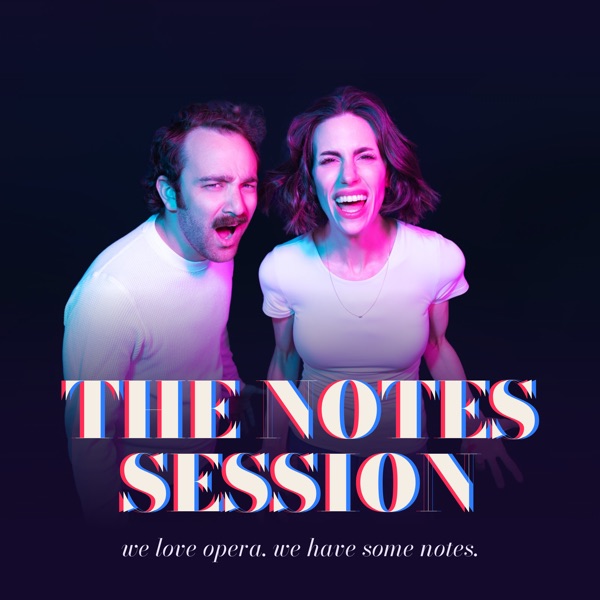
The Notes Session cover art

The Notes Session

The Notes Session

A Performing Arts and Arts podcast

Good podcast? Give it some love!

About the show

We love opera. We have some notes. Welcome to The Notes Session. We are two American opera singers who trained in the US, built careers in Europe, and have spent years swapping voice notes about the art form. Now we're doing it with microphones. What can you expect? Mainly something we're calling "consensus punditry," along with live-show reports, long-form researched video essays, guest conversations, close listening to great singing, and discussions about the industry's sticky questions. New episodes (most) Thursdays. We're glad you're here.

Newest episodes

Episode 6: First, Get to the End · Interview with Nick Brownlee

1 hr 9 min

EP 06 · Guest Interview · "First, Get to the End" -- Interview with Nick Brownlee What makes a Wagner singer, and what makes a Wagner staging worth the fuss? Theo sits down in Munich with one of his best friends, bass-baritone Nick Brownlee. Nick has just sung every note of Wotan in Tobias Kratzer's new Ring at the Bayerische Staatsoper (maybe not every word). He and Theo get into what Wagner actually asks of a voice, why Bayreuth's covered pit changes everything, and why Kratzer's production earns every car, horse, and pizza oven it puts on stage. It's two baritones talking shop for a little over an hour, and it ends with a case for curiosity. In this episode: Wagner, from the practice room to the stage door — * immediacy of sound, and why it isn't the same as volume, * bel canto singing versus bel canto style, * Bayreuth's covered pit, and the one stage where Nick doesn't drag, * "first, get to the end": the order of business for every Wagner lead, * reverence, not reference: Kratzer, Kosky, and the score as Bible, * "why is it an opera?" and never looking at your watch, * booing, thoughtfulness, and whether the golden age was really better. Contains strong language. Follow The Notes Session. Instagram: @thenotessession @jacquelynstucker @talesofhoffman @brownlee_bass_baritone Want to listen to us on YouTube? Listen here: https://www.youtube.com/@thenotessession Episodes released (most) Thursdays. We're glad you're here. Follow The Notes Session @thenotessession, Jacquelyn Stucker @jacquelynstucker, and Theo Hoffman @talesofhoffman on Instagram.

💥 BONUS NOTE 💥 DON GIOVANNI at the Royal Ballet and Opera

31 min

Bonus Note: The Art of Looking (just the RBO DON GIOVANNI) A spontaneous (and the inaugural) Bonus Note, and a little Election Day gift whether you’re celebrating or not. Tomorrow’s Field Note is a long one — philosophy, research, two operas, and it's a solo episode with Jackie. This is the half you might want on its own: Jackie’s review of Kasper Holten’s Don Giovanni at the Royal Ballet and Opera, as she saw it live this autumn. Es Devlin’s revolving house, the names on the walls, three women seen through one man’s eyes, and an ending that cuts the epilogue and leaves him alone with us. Half an hour, and this is a note that couldn't be emailed. The good news? You don’t have to wait until Thursday afternoon. The full Field Note, The Art of Looking: Don Giovanni and 4.48 Psychosis at the Royal Ballet and Opera, is out tomorrow (Thursday, duh). We're glad you're here. Follow us on Instagram: @thenotessession @jacquelynstucker @talesofhoffman

Episode 5: The Art of Looking · DON GIOVANNI and 4.48 PSYCHOSIS at the Royal Ballet and Opera

56 min

EP 05 · Field Notes · The Art of Looking: Don Giovanni and 4.48 Psychosis at the Royal Ballet and Opera Two operas about looking, centuries apart, performed in the same building at the same time. A solo Field Note from Jackie. Upstairs at the Royal Ballet and Opera, Kasper Holten’s Don Giovanni: a man looks at women and decides what they are, and when his consciousness ends, they vanish with it. Downstairs in the Linbury, Philip Venables’ 4.48 Psychosis, staged by Ted Huffman, where Jackie sang Gwen: a woman who is on stage before you are, lets herself be looked at, and never looks back. It’s thinky, it’s about an hour, and it’s best around one in the morning with a glass of something. In this episode: the five filters for looking — Siri Hustvedt on perception,John Berger on looking as choice, Michael Fried on the object in your way, Kierkegaard on desire as music, Lacan on where desire comes from. Spoilers for The Sopranos, Breaking Bad and Fleabag from about 48:00. This episode discusses 4.48 Psychosis, a work about depression and suicide, without detail. Reading list: A Woman Looking at Men Looking at Women, Siri Hustvedt Ways of Seeing, John Berger “Art and Objecthood” and Absorption and Theatricality, Michael Fried Either/Or, Søren Kierkegaard The Four Fundamental Concepts of Psychoanalysis, Jacques Lacan Follow The Notes Session. Instagram: @thenotessession @jacquelynstucker @talesofhoffman Apple Podcasts: podcasts.apple.com/us/podcast/the-notes-session/id6817488496 Spotify: open.spotify.com/show/7e1oVbaX0AurGsR1bScqwx Episodes released (most) Thursdays. We're glad you're here.

Similar podcasts

All episodes

Episode 6: First, Get to the End · Interview with Nick Brownlee

1 hr 9 min

EP 06 · Guest Interview · "First, Get to the End" -- Interview with Nick Brownlee What makes a Wagner singer, and what makes a Wagner staging worth the fuss? Theo sits down in Munich with one of his best friends, bass-baritone Nick Brownlee. Nick has just sung every note of Wotan in Tobias Kratzer's new Ring at the Bayerische Staatsoper (maybe not every word). He and Theo get into what Wagner actually asks of a voice, why Bayreuth's covered pit changes everything, and why Kratzer's production earns every car, horse, and pizza oven it puts on stage. It's two baritones talking shop for a little over an hour, and it ends with a case for curiosity. In this episode: Wagner, from the practice room to the stage door — * immediacy of sound, and why it isn't the same as volume, * bel canto singing versus bel canto style, * Bayreuth's covered pit, and the one stage where Nick doesn't drag, * "first, get to the end": the order of business for every Wagner lead, * reverence, not reference: Kratzer, Kosky, and the score as Bible, * "why is it an opera?" and never looking at your watch, * booing, thoughtfulness, and whether the golden age was really better. Contains strong language. Follow The Notes Session. Instagram: @thenotessession @jacquelynstucker @talesofhoffman @brownlee_bass_baritone Want to listen to us on YouTube? Listen here: https://www.youtube.com/@thenotessession Episodes released (most) Thursdays. We're glad you're here. Follow The Notes Session @thenotessession, Jacquelyn Stucker @jacquelynstucker, and Theo Hoffman @talesofhoffman on Instagram.

💥 BONUS NOTE 💥 DON GIOVANNI at the Royal Ballet and Opera

31 min

Bonus Note: The Art of Looking (just the RBO DON GIOVANNI) A spontaneous (and the inaugural) Bonus Note, and a little Election Day gift whether you’re celebrating or not. Tomorrow’s Field Note is a long one — philosophy, research, two operas, and it's a solo episode with Jackie. This is the half you might want on its own: Jackie’s review of Kasper Holten’s Don Giovanni at the Royal Ballet and Opera, as she saw it live this autumn. Es Devlin’s revolving house, the names on the walls, three women seen through one man’s eyes, and an ending that cuts the epilogue and leaves him alone with us. Half an hour, and this is a note that couldn't be emailed. The good news? You don’t have to wait until Thursday afternoon. The full Field Note, The Art of Looking: Don Giovanni and 4.48 Psychosis at the Royal Ballet and Opera, is out tomorrow (Thursday, duh). We're glad you're here. Follow us on Instagram: @thenotessession @jacquelynstucker @talesofhoffman

Episode 5: The Art of Looking · DON GIOVANNI and 4.48 PSYCHOSIS at the Royal Ballet and Opera

56 min

EP 05 · Field Notes · The Art of Looking: Don Giovanni and 4.48 Psychosis at the Royal Ballet and Opera Two operas about looking, centuries apart, performed in the same building at the same time. A solo Field Note from Jackie. Upstairs at the Royal Ballet and Opera, Kasper Holten’s Don Giovanni: a man looks at women and decides what they are, and when his consciousness ends, they vanish with it. Downstairs in the Linbury, Philip Venables’ 4.48 Psychosis, staged by Ted Huffman, where Jackie sang Gwen: a woman who is on stage before you are, lets herself be looked at, and never looks back. It’s thinky, it’s about an hour, and it’s best around one in the morning with a glass of something. In this episode: the five filters for looking — Siri Hustvedt on perception,John Berger on looking as choice, Michael Fried on the object in your way, Kierkegaard on desire as music, Lacan on where desire comes from. Spoilers for The Sopranos, Breaking Bad and Fleabag from about 48:00. This episode discusses 4.48 Psychosis, a work about depression and suicide, without detail. Reading list: A Woman Looking at Men Looking at Women, Siri Hustvedt Ways of Seeing, John Berger “Art and Objecthood” and Absorption and Theatricality, Michael Fried Either/Or, Søren Kierkegaard The Four Fundamental Concepts of Psychoanalysis, Jacques Lacan Follow The Notes Session. Instagram: @thenotessession @jacquelynstucker @talesofhoffman Apple Podcasts: podcasts.apple.com/us/podcast/the-notes-session/id6817488496 Spotify: open.spotify.com/show/7e1oVbaX0AurGsR1bScqwx Episodes released (most) Thursdays. We're glad you're here.

Episode 4: MONSTERS, Part 1 · "The Stain"

39 min

We couldn’t release a book called Monsters on any day but Halloween. This is the first of three parts on Claire Dederer’s Monsters: A Fan’s Dilemma, the best answer we’ve read to a question we think every opera lover eventually gets asked: how do you justify liking the beautiful things made by monstrous people, and do you even need to? In Part 1 of this three-part series, we walk through the structure Dederer builds in her first fifty pages. Stop asking about the monster and ask about the audience. Admit that your reaction is a moral feeling, not an ethical argument. Accept that the stain doesn’t wash out: “separate the art from the artist” isn’t wrong, it’s impossible. And then, the release: how you consume art doesn’t make you a good person or a bad one. Along the way: Polanski, Woody Allen, Michael Jackson, Wagner, a confession about David Foster Wallace, and the extra step we think performers owe that audiences don’t. Part 2 ("The Fan and the Critic") comes in November, followed by Part 3 ("The Maestro as a Product of His Time") in December. Content note: this episode discusses the sexual abuse of a child, as described in Dederer's text. We'd love for you to read along with us. Find the book at your library or here on ⁠bookshop.org⁠. (Amazon is not TNS-approved.)

Episode 3: Fantasy Football · Britten's A MIDSUMMER NIGHT'S DREAM

1 hr 2 min

It’s draft day. Welcome to the league. Neither of us has ever played fantasy football, but we’re pretty sure this is how it works. In our new series, we draft a dream production of an opera we love: cast, conductor, director, designers and venue. First up is Britten’s A Midsummer Night’s Dream, which we think might be the best operatic setting of Shakespeare. It has fifteen principal roles across three worlds: the fairies, the Athenians, and the Mechanicals. Here are the rules: no casting ourselves or anyone we’ve sung this opera with. Living artists only, but legends get their own episodes. We’re after debuts we’re dying to hear, and every pick is a compliment. Thanks to Isla Mundell-Perkins, Director of Artistic Administration at Festival d'Aix-en-Provence and Casting Consulting for Malmö Opera, whose dream-casting habit inspired this segment. The episode also has a time-traveling children’s quartet and a shout-out to Robert Carsen’s iconic production of this show. There are way more great singers than roles. If someone you love isn’t here, it’s not a snub. So, send us your draft: the blank board is in our Instagram stories at @thenotessession. Tap "Add Yours" and tag us.

Episode 2: You Know It When You See It · DIE WALKÜRE at the Bayerische Staatsoper

46 min

In July, Theo dragged Jackie (decidedly not a Wagner fan) to the Bayerische Staatsoper's Oper für Alle to watch Tobias Kratzer's new production of Die Walküre on the big screen in the plaza outside the opera house. Nearly five hours of Wagner later, she was profoundly moved, and we recorded this the next morning. Our conversation is grounded in this production, but we used it as a jumping-off point for a wide-ranging conversation about period pitch, Jungian archetypes, and the ethics of liking work made by horrible people. This is the start of our coverage of Kratzer's Ring in Munich. More when Siegfried opens in November. Mentioned: Claire Dederer's MONSTERS: A Fan's Dilemma https://bookshop.org/search?keywords=Monsters+Claire+Dederer More on this book is coming soon. Watch on YouTube: [YOUTUBE LINK] Listen on Apple Podcasts: [APPLE LINK] Listen on Spotify: [SPOTIFY LINK] Hosted by Jackie Stucker and Theo Hoffman · Instagram @thenotessession We love opera. We have some notes. New episodes (most) Thursdays.

Episode 1: No Better Way · A Framework for Onstage Nudity

1 hr 29 min

NB: frank discussion of onstage nudity. When is nudity onstage the only way to tell the story? Jacquelyn Stucker and Theo Hoffman have both done it: Jackie in a love scene in L'incoronazione di Poppea at the Festival d'Aix-en-Provence, and Theo in a mad scene in Iphigénie en Tauride at the Opéra-Comique. We both thought it was the right call. In our first Consensus Punditry episode, we try to work out what made it right, and why the answer turned out to be the same both times. In this episode: Two reviews, two productions: what critics see, and what they can'tThe four conditions: necessity, authorship, consensus and conviction, and why nudity reads as story rather than shock only when all four are true at onceWhat the audience sees: why the fourth condition is the only one visible from the house, and what "gratuitous" usually meansFrom the inside: how each of us got there, with a caveat up front: we both had good experiences, and we know that isn't universal Next up, 22 October: Field Notes, our reaction to Tobias Kratzer's Die Walküre at the Bayerische Staatsoper. New episodes (most) Thursdays. We're glad you're here.

Episode 0: Why Are We Here?

18 min

We are Jacquelyn Stucker and Theo Hoffman, the creators and co-hosts of The Notes Session. Despite having similar artistic sensibilities and lots of friends in common, we somewhere were almost never in the same city at the same time, so we traded messages about whatever was exciting, frustrating or inspiring us in opera. When those voice notes finally left the chat, they became The Notes Session. In this episode, we cover: - Who we are: mid-career American soloists working in opera and concert in the US and Europe; - How this podcast started and why we're launching it now; - What we're doing that's different; - Our values: curiosity over criticism, positive language (but not positivity for its own sake), knowing that our preferences aren't objective fact, and sticky ideas over gossip; - And, what you can expect: "consensus punditry," live-show reports, conversations with very smart guests, close listening to great singing, and longer research-driven deep dives. Next week, we're releasing our first "Consensus Punditry" episode, titled No Better Way. We're asking the question of when is nudity onstage the only way to tell the story, and we think we've got a working hypothesis. New episodes (most) Thursdays. We're glad you're here.

–

0 ratings from members

5
4
3
2
1

Rate this podcast

Log in to rate and review the shows you listen to.

No reviews yet — be the first member to rate "The Notes Session".

This podcast, its content and its artwork are not owned by, affiliated with, or endorsed by Castquire.

Keep listening

Discover more podcasts like this.

Up next

  1. Nothing queued. Use + Queue on any episode to line it up.

0:00 0:00